
Curated Resources
MHST 601: Facilitating Health Inquiry
MHST 631: Health Promotion I: Foundation
MHST 631 Artifacts
The following artifacts and resources provide a glimpse into my Health Promotion learning journey.

Health Promotion Organization, Community Engagement Framework
The National Collaborating Centre for Determinants of Health (2013) (NCCDH) provides an excellent resource that summarizes organizations and their community engagement initiatives.
The Canadian Coalition for Seniors' Mental Health (CCSMH) offers a robust community engagement strategy. The NCCDH document was used to organize and summarize the CCSMH community engagement efforts.
Organization: The Canadian Coalition for Seniors' Mental Health (CCSMH)
URL: https://ccsmh.ca/
Area(s) of Focus:
-
Canada, older adults, mental health – anxiety, behavioural and psychological symptoms of dementia, depression, delirium, social isolation and loneliness, substance use and addition, suicide risk and prevention, wellness in aging
Relevance to social determinants of health and health equity:
-
Moderate (equity focussed, advocacy, culturally relevant interventions that recognize the diversity of older adult populations)
Intended Use:
-
Focuses on supporting older adults' mental health through information, resources, professional development and clinical guidelines
Principles/Values:
-
To promote the mental health of seniors by connecting people, ideas and resources
-
Improving the quality of care and support for older adults
Tools/Guides:
-
Canadian Clinical Guidelines on Social Isolation and Loneliness
-
Behaviours in Dementia Toolkit
-
The Social Isolation and Loneliness in Older Adults clinician pocket card - overview of recommendations for assessment and treatment
-
Screening tools- evidence-based method for assessing risk and informing appropriate interventions
-
Assessment of Social Isolation and Loneliness in Older Adults Info Sheet
-
Canadian Guidelines for the Assessment and Treatment of Anxiety in Older Adults
-
Canadian Clinical Practice Guidelines for Assessing and Managing Behavioural and Psychological Symptoms of Dementia
-
Canadian Clinical Guidelines on Delirium Older Adults
-
Canadian Clinical Guidelines on the Assessment of Suicide Risk and Prevention of in Older Adults
-
Social Isolation and Healthy Aging for Older Adults and Care Partners
-
Qualitative National Survey of Older Adults, the story of social isolation and loneliness for older adults in Canada
Strategies:
-
Communication and collaboration with older adults, clinicians and care partners through focus groups and interviews
-
Online engagement tools and digital participation platforms
-
eLearning modules and conferences
Barriers/Risks:
-
Clinical recommendations are most helpful when implemented within a strong relational context
-
Improve use case and operationalizing clinical guidelines
-
Lack of literature on clinical practice in prevention, screening, assessment and intervention for older adults
-
Gaps in research and knowledge reflect opportunities for future consideration
-
Healthcare service providers and their organizations need support to fulfill this role
-
Longitudinal monitoring of social isolation and loneliness in population surveys to evaluate trends and the impact of local, provincial and national interventions
-
Further research and investment in supporting programs for older adults from racialized groups, Indigenous, 2SLGBTQIA+ communities, and diverse linguistic and cultural groups is required
Success Factors:
-
Strong community partnerships
-
Early and continuous engagement, clear goals, strong local partnerships, transparent reporting of outcomes and future considerations
Evaluation:
-
Offers several resources, info sheets/quick facts, screening tools and clinical guidelines to support clinicians, older adults and their care partners in better understanding seniors’ mental health and aging well
Other Comments:
-
CCSMH recognizes the importance of advocacy and building general awareness about the mental health needs of older adults
-
Committed to shedding light on the unique challenges faced by older adults
-
Advocating for improved mental health care policies and resources at all levels of government and through the private sector
Template adapted from National Collaborating Centre for Determinants of Health (community engagement).
https://nccdh.ca/resources/entry/a-guide-to-community-engagement-frameworks/
Brief Presentation:
Highlights of my health promotion proposal and model
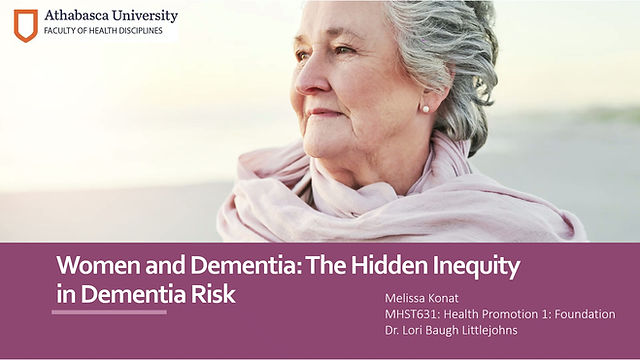
Infographic
Women and dementia: the hidden inequity in dementia risk
Creating this infographic was a valuable learning experience that allowed me to focus on a significant population health issue that disproportionately affects women. Analyzing health outcomes, along with the role of various determinants in shaping them, was particularly eye-opening. Examining both individual determinants and their interactions highlighted how these factors influence women’s health and where targeted research and interventions are needed.
Condensing complex information into a single infographic was challenging, but it provided a useful exercise in prioritizing the most impactful and relevant content.


Multi-level Health Approaches
Mental Health and the Biopsychosocial Model of Health
Alami, H., Lehoux, P., Shaw, S. E., Papoutsi, C., Rybczynska-Bunt, S., & Fortin, J.-P. (2022). Virtual Care and the Inverse Care Law: Implications for Policy, Practice, Research, Public and Patients. International Journal of Environmental Research and Public Health, 19(17), 10591. MDPI AG. Retrieved from http://dx.doi.org/10.3390/ijerph191710591
Devita, M., De Salvo, R., Ravelli, A., De Rui, M., Coin, A., Sergi, G., & Mapelli, D. (2022). Recognizing Depression in the Elderly: Practical Guidance and Challenges for Clinical Management. Neuropsychiatric disease and treatment, 18, 2867–2880. https://doi.org/10.2147/NDT.S347356
Flow Coaching Academy. (2021, July 6). The COM-B model [Video]. Youtube. https://youtu.be/9uUXgMNS23k
Trauma Informed Care Implementation Resource Centre. (n.d.) What is trauma informed care.
https://www.traumainformedcare.chcs.org/what-is-trauma-informed-care/
Rotter, M., Compton, M., Samaranayake, D., Ehntholt, A., Baldwin, E., Schaeffer, L., Feeney, S., & Smith, T. E. (2022). The Social Determinants of Mental Health: A Descriptive Study of State Mental Health Agencies’ Priorities. Community Mental Health Journal, 58(6), 1121–1129. https://doi.org/10.1007/s10597-021-00921-7

Chronic Diseases
The Bi-directional Relationship of Depression, Dementia and Chronic Disease
Behaviour Supports Ontario. (2019, May). Resource manual informing person and family-centred care through objective and measurable direct observation documentation.
Devita, M., De Salvo, R., Ravelli, A., De Rui, M., Coin, A., Sergi, G., & Mapelli, D. (2022). Recognizing Depression in the Elderly: Practical Guidance and Challenges for Clinical Management. Neuropsychiatric disease and treatment, 18, 2867–2880. https://doi.org/10.2147/NDT.S347356
Mental Health Commission of Canada. (2019). Summary: Guidelines for comprehensive mental health services for older adults in Canada. https://mentalhealthcommission.ca/wp-content/uploads/2021/08/Summary_Senior_Guidelines_Eng.pdf
Mount Sinai. (2013, April). Non-pharmacological assessment and management of behavioural and psychological symptoms of dementia in primary care.
Public Health Agency of Canada. (2022, September 1). Dementia: Risk factors and prevention. https://www.canada.ca/en/public-health/services/diseases/dementia/risk-factors-prevention.html?utm_campaign=hc-sc-dementia-risk-23-24&utm_medium=sem&utm_source=bing&utm_content=ad-text-en&utm_term=avoid%20dementia&adv=2324-457500&id_campaign=698168722&id_source=1256743098689069&id_content=78546570504549&gclid=ebfca4cf818d19ca459ac189ff488420&gclsrc=3p.ds
Public Health Agency of Canada. (2017, September 21). Dementia in Canada, including alzheimer's disease: Highlights from the Canadian chronic disease surveillance system. https://www.canada.ca/en/public-health/services/publications/diseases-conditions/dementia-highlights-canadian-chronic-disease-surveillance.html#tb
Public Health Agency of Canada. (2016, December 30). What is depression. https://www.canada.ca/en/public-health/services/chronic-diseases/mental-illness/what-depression.html
World Health Organization. (2023, October 20). Mental health of older adults. https://www.who.int/news-room/fact-sheets/detail/mental-health-of-older-adults
Zenebe, Y., Akele, B., W/Selassie, M., & Necho, M. (2021). Prevalence and determinants of depression among old age: a systematic review and meta-analysis. Annals of general psychiatry, 20(1), 55. https://doi.org/10.1186/s12991-021-00375-x

Indigenous Peoples Health in Canada
Mental Health Considerations for Indigenous Elders
Boksa, P., Joober, R., & Kirmayer, L, J. (2015). Mental wellness in Canada’s Aboriginal communities: striving toward reconciliation. Journal of Psychiatry & Neuroscience. 40 (6), 363-365. DOI: https://doi.org/10.1503/jpn.150309
Hadjipavlou, G., Varcoe, C., Tu, D., Dehoney, J., Price, R., & Browne, A.J. (2018). “All my relations”: experiences and perceptions of Indigenous patients connecting with Indigenous Elders in an inner-city primary care partnership for mental health and well-being. Canadian Medical Association Journal. 190 (20), E608-E615. DOI: https://doi.org/10.1503/cmaj.171390
Lindeman, M., Mackell, P., Lin, X., Farthing, A., Jensen, H., Meredith, M., & Haralambous, B. (2017). Role of art centres for Aboriginal Australians living with dementia in remote communities. Australasian Journal on Ageing, 36(2), 128–133. https://doi.org/10.1111/ajag.12443
Tu, D., Hadjipavlou, G., Dehoney, J., Price, E. R., Dusdal, C., Browne, A. J., & Varcoe, C. (2019). Partnering with Indigenous Elders in primary care improves mental health outcomes of inner-city Indigenous patients: Prospective cohort study. Canadian Family Physician Medecin de famille canadien, 65(4), 274–281. https://www.ncbi.nlm.nih.gov/pmc/articles/PMC6467659/
Viscogliosi, C., Asselin, H., Trottier, L., D’Amours, M., & Levasseur, M. (2022). Association between intergenerational solidarity involving elders and mental health of Indigenous people living off reserve. BioMed Central Public Health, 22(1), 1–7. https://doi.org/10.1186/s12889-022-12887-6
Webkamigad, S., Warry, W., Blind, M., & Jacklin, K. (2020). An approach to improve dementia health literacy in Indigenous communities. Journal of Cross-Cultural Gerontology, 35(1), 69–83. https://doi.org/10.1007/s10823-019-09388-2
Wu, J., Smye, V., Hill, B., Antone, J., & MacDougall, A. (2023). Exploration of existing integrated mental health and addictions care services for Indigenous peoples in Canada. International Journal of Environmental Research and Public Health, 20(11), 5946. https://doi.org/10.3390/ijerph20115946

Marginalized Groups
Intersectional Feminism in Canada
Al-Faham, H., Davis, A. M., & Ernst, R. (2019). Intersectionality: From theory to practice. Annual Review of Law and Social Science, 15(1), 247-265. https://www.researchgate.net/publication/336434914_Intersectionality_From_Theory_to_Practice
Canadian Woman’s Foundation. (n.d.). The facts about intersectional feminism in Canada. https://canadianwomen.org/the-facts/intersectional-feminism/
Minority Rights Group International (n.d.). Discrimination, a global overview. https://stories.minorityrights.org/lifeatthemargins/home/
Public Health Agency of Canada. (2022, June 13). How to integrate intersectionality theory in quantitative health equity analysis? A rapid review and checklist of promising practices. https://www.canada.ca/en/public-health/services/publications/science-research-data/how-integrate-intersectionality-theory-quantitative-health-equity-analysis.html
Sociological Studies Sheffield. (2020, October 8). Intersectionality and health explained [Video]. YouTube. https://youtu.be/rwqnC1fy_zc?si=AmiVTglJJlIZzzuJ
The Canadian Research Institute for the Advancement of Women. (n.d.). Feminist intersectionality and GBA+. https://www.criaw-icref.ca/our-work/feminist-intersectionality-and-gba/
The Prosperity Project. (2022, February 16). Women with intersecting identities underrepresented in Canadian leadership. https://blog.canadianprosperityproject.ca/women-with-intersecting-identities-underrepresented-in-canadian-leadership/
UN Woman. (2020, July 1). Intersectional feminism: what it means and why it matters right now. https://www.unwomen.org/en/news/stories/2020/6/explainer-intersectional-feminism-what-it-means-and-why-it-matters

The Future of Healthcare in Canada
Trending: Intergenerational Living
Canada Home Share. (2023, November 25). Frequently asked questions. https://www.canadahomeshare.com/
Generations United. (2023, November 26). Intergenerational programs and spaces. https://www.gu.org/who-we-are/
Fang, M. L., Sixsmith, J., Hamilton-Pryde, A., Rogowsky, R., Scrutton, P., Pengelly, R., Woolrych, R., & Creaney, R. (2023). Co-creating inclusive spaces and places: Towards an intergenerational and age-friendly living ecosystem. Frontiers in public health, 10, 996520. https://doi.org/10.3389/fpubh.2022.996520
Jacobs, K. (2021, September 2). Don’t mind the gap in intergenerational housing. The New York Times. https://www.nytimes.com/2021/09/02/style/housing-elderly-intergenerational-living.html
Public Health Agency of Canada. (2006, July 18). Age-friendly rural and remote communities: A guide. https://www.canada.ca/en/public-health/services/health-promotion/aging-seniors/publications/publications-general-public/friendly-rural-remote-communities-a-guide.html
Sudo, C. (2021, May 31). How intergenerational living is shaping new senior housing models post-pandemic. Senior Housing News. https://seniorhousingnews.com/2021/05/31/how-intergenerational-living-is-shaping-new-senior-housing-models-post-pandemic/
Suleman, R., & Bhatia, F. (2021). Intergenerational housing as a model for improving older-adult health. BC Medical Journal, 63(4), 171-173. https://bcmj.org/articles/intergenerational-housing-model-improving-older-adult-health

This is your Project description. Click on "Edit Text" or double click on the text box to start.